
Tsushima island is Japan at its least packaged: a forested border island in the strait between Kyushu and Korea, closer to Busan than to Fukuoka. Millions know it from Ghost of Tsushima; almost nobody visits. Those who do find a 7th-century mountain fortress, a wildcat that exists nowhere else on earth, and fishing towns where the menus never saw a tour group. This guide covers the boats, the two-day route, and what actually deserves your time.
What to Expect
Tsushima is one long ridge of mountain forest rising from the sea, nearly 70 km top to bottom, split into a northern and a southern half by the fjord-like sprawl of Asō Bay. Around 30,000 people live here, most of them in Izuhara in the south and Hitakatsu in the north. There is no rail, little bus service and no tourist strip. You come for landscape, history and quiet, and you drive to all three.
Izuhara and the south
Izuhara is the old castle town of the Sō clan, the family that governed Tsushima for centuries and ran Japan's diplomacy with Korea; when relations were good, official missions from the Korean court passed through this harbour on their way to Edo. Stone walls and temple gates still line its backstreets, and it works best as your day-one base.
Sleep at Seizanji, a working Buddhist temple above the harbour that takes overnight guests: plain tatami rooms, temple quiet, and a price that undercuts most business hotels.
The town eats well for its size, and everything sits within a few minutes' walk in the centre:
- Otako: the local tonkatsu benchmark.
- Meshiya: the izakaya for a first-night spread.
- Shioji: the island's seafood as a set course, for one good dinner done properly.
- Tsushima Burger KIYO: the namesake lunch, a patty flecked with hijiki seaweed under grilled squid.
Order conger eel wherever a menu offers it: Tsushima lands more anago than anywhere else in Japan, and the sashimi version barely travels beyond the island. The other names to know:
- Rokubee: chewy dark noodles made from fermented sweet potato starch.
- Tonchan: marinated grilled pork, brought by Korean settlers and now the island's soul food.
- Ishiyaki: the day's catch grilled table-side on a fire-heated stone, still served at some inns.
- Kasumaki: the dessert, sponge cake rolled around red bean paste.
Two short trips and one viewpoint round out the south:
- Ayumodoshi Natural Park: a river gorge of pale granite slabs and clear pools near Tsutsu, at the island's southern tip.
- Komodahama Shrine: behind the west-coast beach where the Mongol fleet landed in 1274 and the island's garrison was wiped out. The game's opening battle is a fiction built on this real morning; the shrine honours the defenders.
- Isaribi Park: the hillside lookout above town, named for the lamps of the squid fleet. Go at dusk, when they switch on offshore.
Asō Bay and the middle island
The island's flagship sight guards its centre. Kaneda Fortress Ruins is a Korean-style mountain fortress built in 667, after Japan's catastrophic naval defeat at Baekgang left the court expecting an invasion from the continent. Its stone ramparts ring the 276-metre Mount Joyama above Asō Bay, and a gun battery from the 1904–05 war with Russia crowns the summit, thirteen centuries of border anxiety stacked on one hill. The path up runs through quiet forest, past walls that have stood since before Kyoto existed, and you will very likely have them to yourself. This is the closest thing Japan has to the castle ruins the game invented.
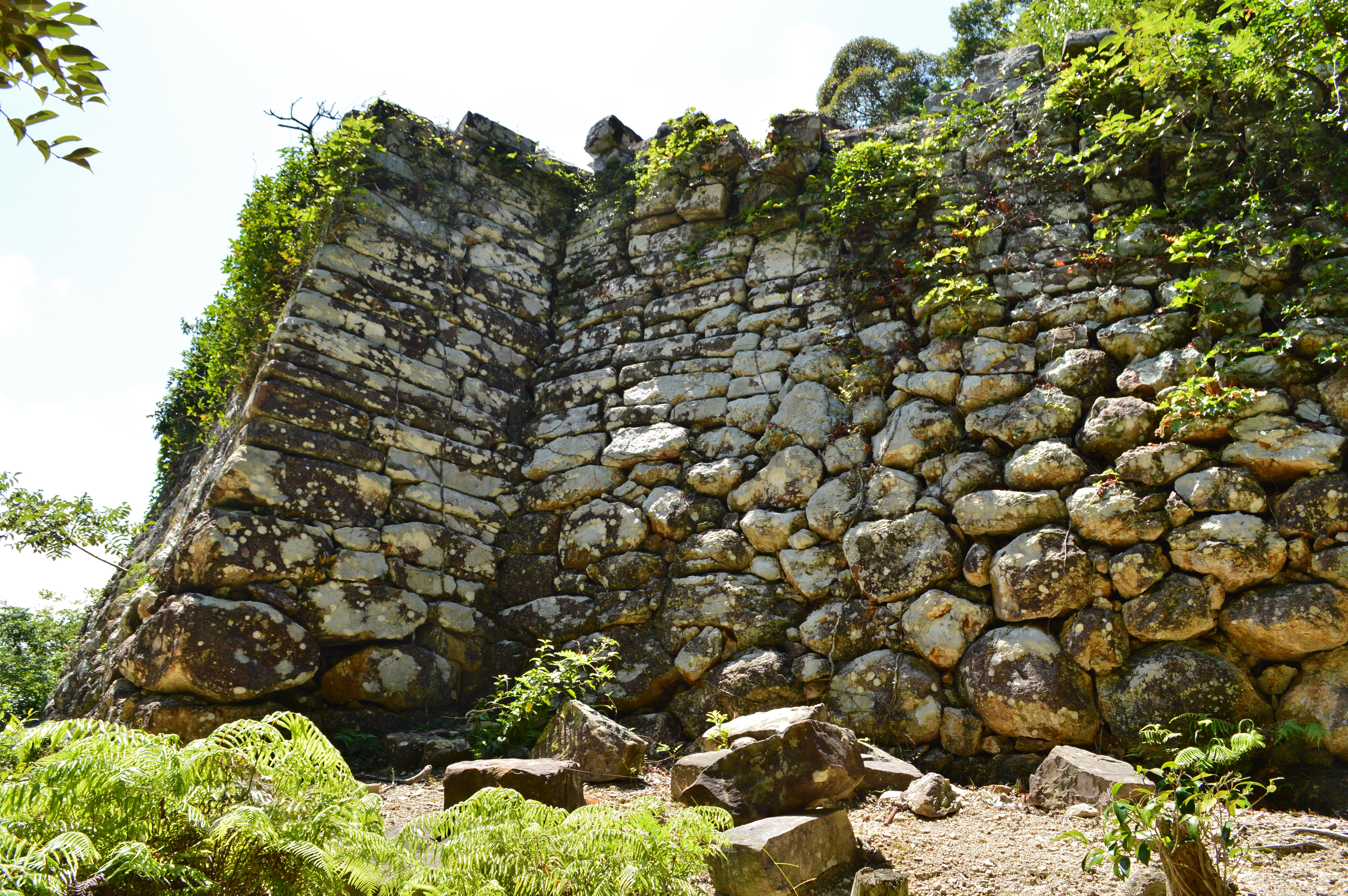
- The climb: about 50 minutes to the summit at a steady pace, on a proper mountain path. Wear real shoes.
- Cost: free, unstaffed, no gates.
- The reward: ramparts in the forest on the way up, and the whole of Asō Bay from the battery at the top.
Ten minutes' drive south, Manzeki Observation Deck looks down on the narrow channel that separates the island's two halves, a canal the navy cut in 1900 so warships could pass.
The middle island is also where you sleep and bathe in comfort:
- Tsushima Grand Hotel: onsen hotel on the water near the airport. New to hot springs? Our onsen guide explains the etiquette.
- Yuttariland Tsushima Pool: the public bath complex, for a soak without the room.
- Guest House Café Yamaboushi: the budget bed, in Ōfunakoshi.
- En: run by a local fisheries company; the menu is whatever the boats brought in.
The far north: leopard cats and the Korea view
The Tsushima leopard cat lives on this island and nowhere else in Japan. The environment ministry's latest survey, run from 2020 to 2024, put the population at roughly 90–100 animals in the northern half, with at least 17 confirmed in the south, and the trend finally pointing up. You will almost certainly not see one in the wild; they are nocturnal and scarce. The Tsushima Wildlife Conservation Center in the far-north hills is the reliable encounter, with a resident cat on view and the conservation story told properly.
- Open: Wednesday to Sunday, 10:00–16:30, last entry 16:00; closed Monday, Tuesday and over New Year.
- Admission: free.
- Getting there: car only. About 35 minutes from Hitakatsu, 90 minutes from the airport; the final stretch is a rough single-lane road.
On the drive north, stop at Mount Eboshi Observatory in Toyotama for the island's best panorama: the drowned valleys of Asō Bay scattered below in every direction.
Hitakatsu itself is a working port town where high-speed boats from Busan dock, and Korean weekenders often outnumber Japanese travellers on the street. From the capes beyond it, Korea sits about 50 km away; on a clear night the glow of Busan hangs on the horizon. No other place in Japan feels this much like a land border.
A two-day circuit that works
The island rewards a south-to-north line rather than a base-and-loop, and drives take longer than the map suggests: the spine road winds. This version assumes the morning jetfoil in and a flight out; reverse it if you fly in, picking up the car at the airport, doing the north first and sailing home from Izuhara.
- Day 1, the south: arrive at Izuhara by jetfoil and collect the rental car. Spend the afternoon climbing to the fortress ruins, catch the squid-boat lamps from Isaribi Park at dusk, eat in the town centre, sleep at the temple.
- Day 2, the north: drive north early with a stop at the Manzeki deck, then the Eboshi lookout, and reach the conservation centre by early afternoon. Either loop back for the evening flight (leave the centre by 15:00; the airport is 90 minutes away) or overnight near Hitakatsu and sail back from there, checking that day's sailings before you commit.
- With a third day: add Ayumodoshi and the Komoda coast in the south, unhurried.
When to go
May–June and September–October are the island at its best: mild, green and clear-watered, with calm crossings. Summer is hot, humid and typhoon-exposed, and rough weather is the one thing that reliably disrupts Tsushima plans, because everything arrives and leaves by sea or a small airport. Winter is quiet and entirely workable if you dress for wind. Book boats and beds well ahead of Golden Week and August; the island's capacity is small enough that both sell out.
Tsushima instead of a second Nagasaki day
Nagasaki prefecture counts 1,479 islands, 72 of them inhabited, and most travellers see none of them. The prefecture has started saying this out loud: its tourism board now promotes the castle ruins scattered across four of its islands, with Kaneda as the headline act. If you have already done Nagasaki city, the case for a second mainland day is thin, and the case for the 2 h 15 min jetfoil is not. Tsushima trades another museum queue for a border island with its own wildcat, its own war history and its own food. It belongs on any list of hidden gems in Japan, and it is the least crowded major sight in Kyushu's orbit.
How to Get There
Getting There
- 1Kyushu Yusen Venus jetfoil via Iki → Izuhara
The jetfoil is the only vessel you can book online; reserve ahead in summer and around holidays.
- 1Car ferry via Iki → Izuhara
A separate car ferry sails Hakata to Hitakatsu direct in about 4 h 55 min (¥7,540), useful for a north-to-south itinerary.
- 1Fly ANA or its regional partner → Tsushima Airport
Around five flights a day; Nagasaki Airport has a similar 35-minute hop. There is no boat from Nagasaki city, only from Hakata.
Tips
- Book the rental car with the boat. The island effectively requires one; buses are sparse and the conservation centre has no public transport at all. Stock is small, so reserve when you book the crossing.
- Bring more cash than feels reasonable. Card acceptance is patchy outside hotels; post-office ATMs take foreign cards, so plan withdrawals around their hours.
- Download offline maps before you drive. Mobile signal is fine in the towns and drops on mountain roads and trails.
- Drive slowly at dusk in the north. Road deaths are a leading cause of leopard cat mortality, and the northern roads carry warning signs for a reason.
- Medical cover exists mid-island. The main general hospital, with around 275 beds, sits in Mitsushima near the airport.
- Leave slack in the return leg. Boats cancel in rough weather; never book an onward international connection for the same day.
Nearby
Start with our Tsushima overview, then see the rest of the prefecture beyond the mainland circuit.
FAQ
Is Tsushima the real island from Ghost of Tsushima?
Yes. The game is set on this island and built on a real event, the Mongol landing of 1274 at Komoda beach, though its geography and characters are invented. The closest real-world match to the game's castle ruins is the 7th-century Kaneda fortress above Asō Bay.
Can you actually see a Tsushima leopard cat?
In the wild, almost never: the cats are nocturnal and number only around 90–100 in the island's north. The Tsushima Wildlife Conservation Center keeps a resident cat on view and is free to visit, Wednesday to Sunday. Going in, know that it is a 90-minute drive north of the airport.
Do you need a car on Tsushima?
Effectively yes. The island is nearly 70 km long, buses are sparse, and headline sights like the conservation centre are unreachable without one. Book the car when you book the boat; rental stock is limited.
How many days does Tsushima need?
Two full days covers the south-to-north circuit: Izuhara and the Kaneda fortress on day one, the Manzeki channel, Eboshi lookout and the leopard cat centre on day two. A third day adds the southern gorge at Ayumodoshi and the Mongol landing coast without hurry.
Can you visit Tsushima from Korea?
Yes. High-speed boats connect Busan with Hitakatsu in the island's north, and Korean visitors are a large share of the island's tourism. Coming from Japan, sea access is from Hakata in Fukuoka; there is no passenger boat from Nagasaki city.
