



Japan’s transportation is the country’s most over-praised feature, and even the praise undersells it. Trains run to the second. Stations are bilingual. Drivers don’t take tips. The system was designed to move 35 million Tokyoites and 130 million nationals around the country every day, and a tourist with a Suica card slots into it without friction. The trick is knowing which mode of transport fits which trip, and which to skip entirely. This guide is the overview; every section links to the deep how-to articles for the actual mechanics.
The one thing to do first: get an IC card
A Suica (JR East) or PASMO (Tokyo Metro) IC card replaces 90% of paper tickets. Tap on entry, tap on exit, the fare is automatically deducted. Same card works on every train, metro, bus, ferry, and convenience store across Japan in 2026; there’s no longer a regional restriction. Add it to Apple Wallet (iPhone) or Google Pay (Android) for free; physical cards still exist at any major station for ¥500 deposit.
This single piece of plastic (or phone setting) means you almost never need to interact with a ticket machine. Step-by-step Suica setup on iPhone covers the actual flow.
Long-distance: Shinkansen and the JR network
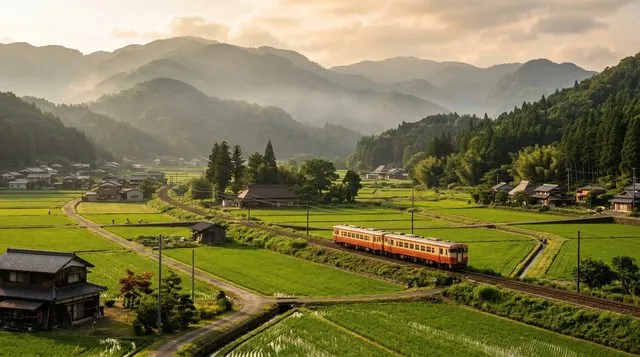
The Shinkansen (bullet train) network covers Hokkaido in the north to Kagoshima in the south, with the main line being the Tokaido (Tokyo–Osaka, 2.5 hrs) and Sanyo (Osaka–Hakata, 2.5 hrs). It’s the gold standard of inter-city transport: faster than flying once you account for airport transfer, and stations are central to the city.
The JR Pass is a flat-rate ticket sold only to short-term foreign visitors. After the 2023 price hike (¥50,000 for 7 days) the maths is more complex than it used to be. The complete JR Pass guide includes a working calculator and the simple decision rules.
For first-timers on the Shinkansen: how Shinkansen actually works covers reserved vs unreserved seats, ekiben, the Smart-EX app, and which side faces Mt. Fuji.
Cities: Metros, JR loops, private railways
Each major city has its own subway/metro system, often run by multiple competing operators on the same network. Tokyo alone has Tokyo Metro (9 lines), Toei (4 lines), JR Yamanote (the famous loop), plus six major private railway companies (Tokyu, Keio, Odakyu, Tobu, Seibu, Keisei).
The IC card abstracts all of this. Tap to enter on any line, tap to exit, and the system charges you correctly across operators. Tokyo Subway with Google Maps covers the four-step workflow that gets you anywhere without learning kanji.
For other cities: Osaka and Kyoto have their own metro systems (much smaller, easier to navigate); Yokohama, Nagoya, Sapporo, Fukuoka, Sendai, Hiroshima all have either subways or tram networks. The tram in Hiroshima specifically pays off via a ¥700 day-pass.
From the airport into the city
Six major international airports serve Japan. The transit options are different for each, and the trick at Tokyo’s two airports is choosing between four equally legitimate train services.
- Narita (NRT, Tokyo): Skyliner (¥2,580, 41 min) is the fastest. N’EX is included with JR Pass. The full breakdown.
- Haneda (HND, Tokyo): Tokyo Monorail (¥520, 15 min) or Keikyu Line (¥530, 25 min direct to Shinagawa).
- Kansai (KIX, Osaka): Haruka Express (¥1,060–1,830) to Kyoto/Tennoji/Shin-Osaka, or Nankai Rapi:t (¥1,490) to Namba.
- Chubu Centrair (NGO, Nagoya): Meitetsu mu-Sky (¥1,250, 28 min) to Nagoya.
- New Chitose (CTS, Sapporo): JR Rapid Airport (¥1,150, 37 min).
- Fukuoka (FUK): Subway Kuko Line (¥260, 5 min). Closest airport-to-city in the country.
Taxis: when they actually beat the train
Japanese taxis have auto-opening rear doors, the meter is honest, and tipping is rude. They’re not a luxury; they’re a tool for late nights, rain, three people with luggage, or restaurants in back-alleys. The GO app (English-language) lets you summon and pay without speaking. Taxis in Japan: the GO app, auto doors, and when they’re worth it covers the whole flow.
Buses
City buses are the fall-back when the train doesn’t go where you need. Pay with the same IC card; enter from the back, tap on the way in, exit through the front, tap again. Fares are flat (¥220–230 in most cities) or distance-based (Kyoto, regional towns).
Long-distance highway buses are the cheap alternative to the Shinkansen: the Tokyo–Kyoto night bus is ¥4,000 vs ¥14,170 by Shinkansen. Slow (8 hours) but you sleep through it. Willer Express and JR Bus operate the most foreigner-friendly services with English booking. Best for budget itineraries or when the Shinkansen is sold out.
Ferries and the islands
Japan has 6,852 islands. The major inhabited ones (Hokkaido, Honshu, Kyushu, Shikoku, Okinawa) are connected by Shinkansen or short flights, but the smaller ones (Sado, Awaji, Yakushima, Naoshima, Miyajima) are only reachable by ferry. JR ferries to Miyajima are included with the JR Pass. Long-distance overnight ferries (Tokyo–Tokushima, Osaka–Beppu) are the slow scenic option.
Domestic flights
For Hokkaido and Okinawa, flying often beats the Shinkansen on time-and-cost. ANA, JAL, and the LCCs (Peach, Jetstar Japan, Skymark) compete on routes like Tokyo–Sapporo (1.5 hrs vs 8 hrs by train) and Tokyo–Naha (3 hrs vs not feasible by train). LCC fares from ¥4,000 if booked weeks ahead.
Bicycles and rentals
Most Japanese cities have rental bikes, often docked-share systems (Hello Cycling is the largest network: ¥130 per 30 min, app-based). Rural areas with major cycling routes (Shimanami Kaido, Naoshima, Hiroshima coast) have dedicated rental stations. Quiet residential Japanese streets are extraordinarily bike-friendly: narrow, slow, and locals expect cyclists on the pavement (yes, on the pavement, this is correct here).
Car rental
Useful only outside the big cities: Hokkaido road trips, rural Kyushu, the Izu peninsula, deep Tohoku. International Driving Permit required (issued in your home country before flying). Toyota Rent-a-Car and ORIX have English-language counters. Drive on the left. Tolls are expensive (¥1,500–3,000 per long expressway leg). Not worth it for Tokyo, Osaka, Kyoto, or any major city.
Luggage forwarding (Yamato Takkyubin)
The hidden trick: ship your suitcase between hotels for ¥2,000–2,500 and travel hands-free. Drop at any 7-Eleven or hotel desk, pick up at the next hotel before 18:00 the next day. The full Takkyubin guide covers the mechanics.
Coin lockers
Every major station has coin lockers (¥400–700 per day) for short-term storage during day trips. The day-bag trick uses them as a hub for hands-free sightseeing.
Connectivity while moving
Most trains and stations have free Wi-Fi, but it’s patchy and requires login per network. An eSIM (Airalo, Ubigi) gives you unlimited mobile data from the moment you land. The eSIM guide covers the setup.
The decision tree, summarised
- Inside one city: IC card on the metro/JR loop. Skip the JR Pass.
- Tokyo–Kyoto–Osaka loop: Shinkansen with point-to-point tickets, or check the calculator on the JR Pass page.
- Tokyo–Kyoto–Hiroshima within 7 days: 7-day JR Pass.
- Tokyo to Hokkaido / Okinawa: domestic flight (LCC).
- Late night, rain, three people with luggage: taxi (GO app).
- Hotel-to-hotel suitcase logistics: Yamato Takkyubin.
- Day trip from a major city: JR / private railway with IC card.
- Long-distance budget: overnight highway bus.