
Gunkanjima, formally known as Hashima Island, is a concrete island less than 500 metres long that once housed more than 5,000 coal miners and their families. Sealed off when its Mitsubishi-operated mine closed in 1974, it reopened to licensed tours in 2009 and was inscribed as a UNESCO World Heritage site in 2015, as part of Japan's Meiji industrial revolution heritage listing. The visual impact is immediate.
What most travel guides skip is the planning side. Island time is capped at 40 to 50 minutes, weather cancels roughly three in ten departures, and the nearby Gunkanjima Digital Museum tells you more about life on the island than the island itself can.
This guide covers how to plan a visit to Nagasaki city that makes the trip worthwhile, from choosing a tour operator to adding Takashima Island as a weather backup or a deeper half-day.
How to get to Gunkanjima
Your match
ConcierGE Nagasaki
Smaller groups with bilingual commentary. Free Digital Museum entry (¥1,800) included. Ticket: ¥5,000–5,500.
You want a smaller group and the museum ticket covered.
Your match
Yamasa Kaiun
Most-booked operator. English guides on four days a week. Two departures at 09:00 and 13:00. Fare: ¥4,810 total.
English commentary matters and any group size is fine.
Your match
Seaman Company
Lowest fare at ¥3,900. Twice-daily departures. Japanese-language website and guides only.
Price is the priority and English commentary is not needed.
Choose your tour operator
Three licensed operators run landing tours to Gunkanjima (Hashima Island) from Nagasaki. The choice affects group size, commentary quality, and departure location:
- Yamasa Kaiun is the most established and the easiest to book in English. English-language guides run on Tuesdays, Thursdays, Saturdays, and Sundays. Adult fare: ¥4,500 plus a ¥310 Nagasaki City landing fee (¥4,810 total). Two daily departures at 09:00 and 13:00. The highest booking volume of the three, so reserve early for spring weekends.
- ConcierGE Nagasaki operates smaller groups with bilingual commentary. Standard tickets cost ¥5,000 to ¥5,500, with premium options offering different viewing angles from the boat. Visitors who book ConcierGE also receive free entry to the Gunkanjima Digital Museum, which offsets some of the price difference. For a more focused experience, this is worth comparing.
- Seaman Company offers the lowest fare at roughly ¥3,900, with twice-daily departures at around 10:30 and 13:40. The website is Japanese only, so booking requires either Japanese-language navigation or help at a tourist information centre in Nagasaki.
Booking and weather
Spring and autumn weekend tours on popular dates sell out two to three weeks in advance. Mid-week departures have more availability and tend to attract smaller groups, meaning shorter queues at the viewing platforms. Book directly through the operator's website: third-party platforms add commission without adding flexibility.
Every operator carries a weather cancellation policy. Sea conditions on the open crossing can prevent the boat from docking even after departure, meaning you may complete the full crossing and return without landing. Read your operator's specific refund terms before paying. If you have firm travel dates and cannot build in a weather day, consider booking the 09:00 departure, which allows time to rebook the 13:00 slot if the morning is cancelled.
Getting to the pier
Yamasa Kaiun departs from their terminal at Nagasaki Port, roughly a 15-minute walk from Nagasaki Station. Tram lines 1 and 5 connect the station to the Dejima area; alight at the Dejima stop and follow signs to the waterfront. Allow at least 20 minutes before your departure time for boarding checks and any last-minute paperwork.
What to expect on the island
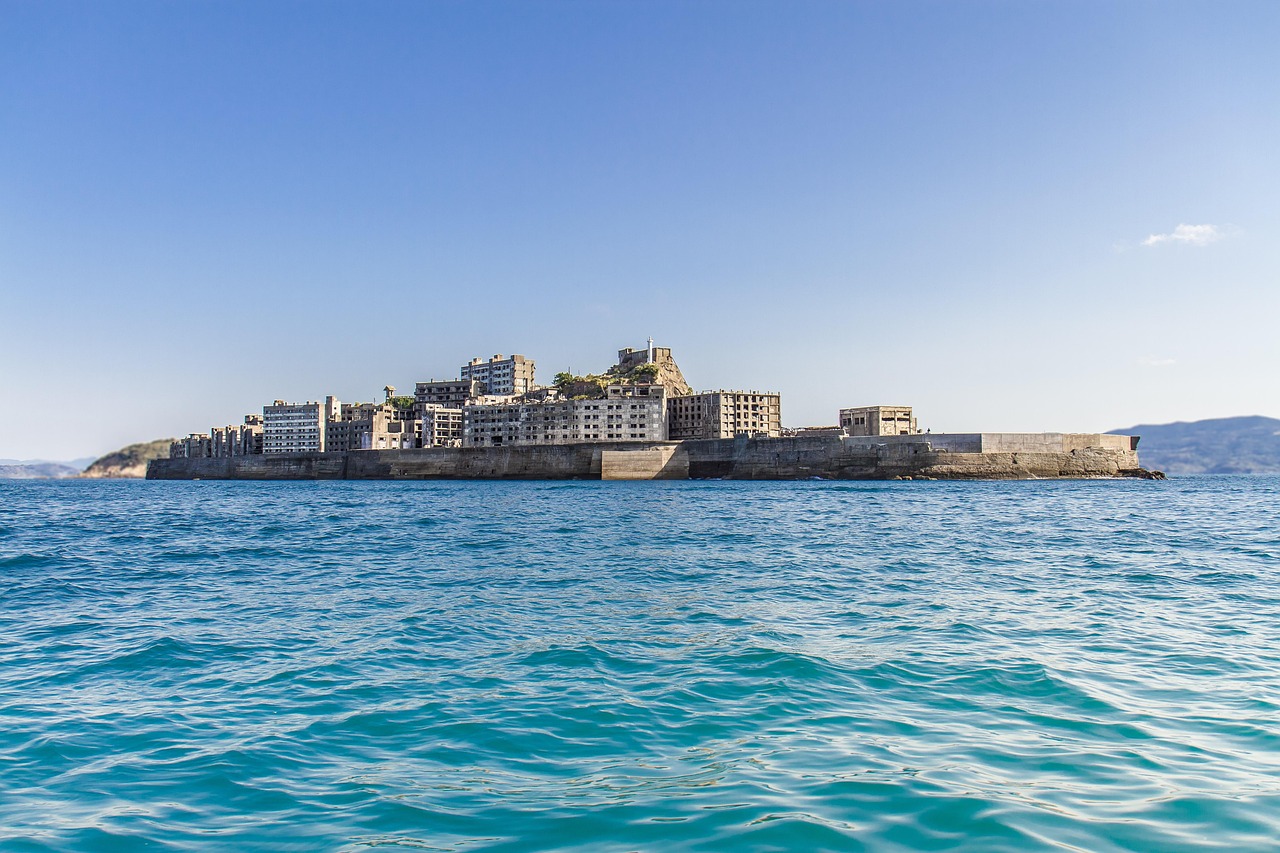
The round trip takes approximately 2 hours 30 minutes in total. Island time is 40 to 50 minutes, spent on a fixed footpath connecting three elevated viewing platforms. There is no free roaming; visitors are guided at all times and the footpath is clearly marked.
The three viewing platforms
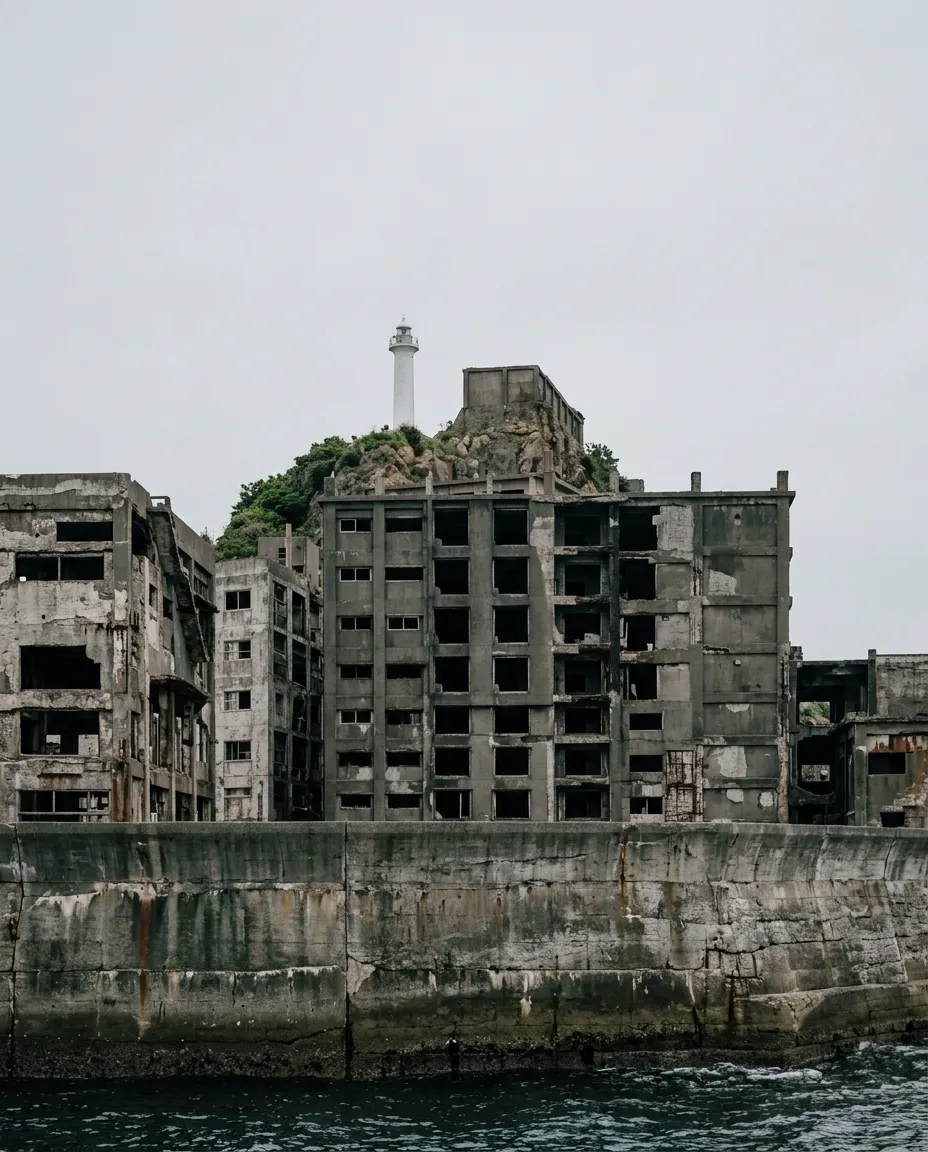
Tours stop at three fixed viewing platforms, each facing a different part of the island:
- Platform 1, the residential district: concrete apartment towers, among the first reinforced concrete housing in Japan, rising from the island's interior. At the mine's peak in the late 1950s, Hashima's population density was the highest ever recorded for any settlement worldwide.
- Platform 2, school and recreation hall: a closer view, with the gymnasium roofline still partially intact. This is where the scale sinks in: entire families shared apartments of roughly 6 square metres.
- Platform 3, the southern end: the old mine shaft entrances and the seawall that gives the island its battleship profile from the water.
A large section of the central ruins has been sealed off since typhoon damage in 2009. The collapsed hospital ward and much of the family housing are visible from the platforms but inaccessible. This is not a failing of the tour; it is the honest state of the island after 50 years of abandonment and coastal weather.
Photography on the island
Take the 09:00 departure. The residential towers face roughly east, so morning light works in your favour, and you arrive before the mid-morning cruise ship groups that dock at Nagasaki Port.
- Focal length: 70mm equivalent or longer, because shooting positions sit 30 to 50 metres from the ruins
- Overcast days: softer shadows on the concrete, often the most coherent images of the structure as a whole
Cloud cover, in other words, is not a reason to reschedule.
Start with the museum
The 40 minutes on the island tell you what the place looked like. The Gunkanjima Digital Museum tells you how it felt to live there, and does so with archival footage and recorded testimonies that the ruins cannot provide.
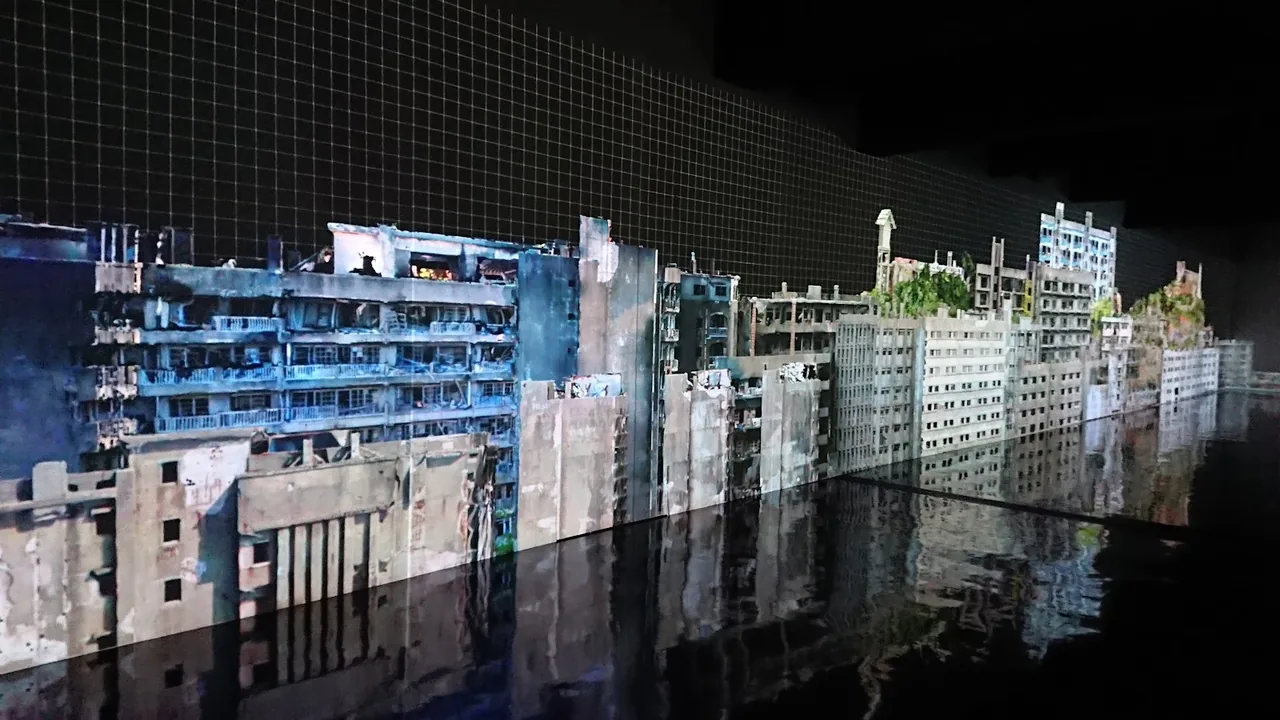
Gunkanjima Digital Museum: the richer companion to the island tour, five minutes from the Dejima pier.
Digital museum
The museum covers six exhibit zones spanning the island's operational years from 1887 to 1974. A scale reconstruction shows the actual apartment dimensions: roughly 6 square metres, the average allocation for a family of four, with shared laundry, communal bathrooms, and rooftop recreation space compensating for the confined interiors. Archival film from the 1960s shows children playing on the school roof, residents fishing from the seawall, and the supply ships that were the only connection to the mainland. Former residents, now elderly, describe what daily life looked like inside a closed industrial community with no cars, no distance to travel for work, and no reason to leave except for school examinations on the mainland.
The museum sits a 5-minute walk from the Dejima waterfront pier, with the Yamasa Kaiun departure point a further 10 minutes on foot. A clean sequencing: arrive at 09:00 when the museum opens, allow 60 to 90 minutes, then walk to the pier for a 13:00 departure. The morning is filled, the tour follows without dead time.
The Takashima alternative
Takashima Island served as the operational base for the Hashima coal mine: the administrative offices, the more senior Mitsubishi management and the supply infrastructure that kept Gunkanjima running all sat here. It sees almost no English-language visitors.
- Ferry from Nagasaki Port: 35 minutes
- Round-trip fare: ¥2,280
Takashima Island: the quiet companion, best for visitors who want depth beyond the Gunkanjima photo stop.
Island day trip
The Takashima Coal Mine Museum, open since 1988, holds original mining equipment and tools evacuated from Hashima when it closed in 1974. It is the only place where physical artefacts from the mine's working life are on display, rather than ruins or digital reconstructions. Takashima's own coal mine, which predated Hashima's by nearly a decade (operations began in 1869), is also documented here. The museum is small and low-profile by design; there are no crowds.
For visitors whose Gunkanjima tour is cancelled by weather, Takashima requires no advance booking and runs on the same ferry system from Nagasaki Port. It is a workable alternative itinerary for the same half-day, not a fallback.
Morning: Gunkanjima Digital Museum
Arrive at the museum when it opens at 09:00. Allow 60 to 90 minutes for all six exhibit zones. Walk 10 minutes to Yamasa Kaiun's pier.
Afternoon: Gunkanjima island
Board your 13:00 tour. Total round-trip time is approximately 2 hours 30 minutes, with 40 to 50 minutes on the island. Return to Nagasaki Port by 15:30–16:00.
Late afternoon: Takashima ferry (optional)
The Nomo Shosen ferry to Takashima runs roughly every 2–3 hours from Nagasaki Port. Check the timetable on the day. A 35-minute crossing plus 30 to 45 minutes at the Coal Mine Museum fits into the late afternoon before the last return ferry. Confirm return times before boarding.
Practical tips
- Best months: April to June and September to October for calmer seas and the lowest cancellation risk. August brings typhoon season; departures during storm warnings are cancelled with no rescheduling.
- What to wear: The crossing is on an open-decked boat in open sea conditions. Wind-resistant layers are advisable even in summer. Flat, closed shoes for the island footpath.
- Time needed: Half a day for the Digital Museum plus the island tour. A full day if you add Takashima in the late afternoon.
- No interior access: All ruins are viewed from three fixed platforms. No climbing, no self-guided routes, no night access. Expect photography conditions, not exploration conditions.
- Group size note: ConcierGE runs smaller groups than Yamasa. If viewing platform congestion is a concern, mid-week Yamasa departures or ConcierGE are the better options.
- Booking lead time: Two to three weeks for spring and autumn weekends. Mid-week dates in most seasons have same-week availability.
- Weather backup: Save the Takashima ferry timetable before you travel (check the Nagasaki city ferry schedule page). If Gunkanjima cancels, the ferry terminal for Takashima is nearby.
Nearby
Worth combining with a full-day Gunkanjima itinerary:
FAQ
Can you visit Gunkanjima without a tour?
No. Access to Hashima Island requires booking through one of three licensed tour operators. Independent travel to the island is not permitted.
What happens if the weather cancels my Gunkanjima tour?
All three operators issue refunds when weather prevents landing. Cancellations can occur on the day itself, including after the boat has departed if sea conditions change mid-crossing. Read the operator's specific refund policy before booking. Takashima Island is a good same-day alternative that requires no advance booking.
How far in advance should I book a Gunkanjima tour?
Two to three weeks for spring and autumn weekends. Mid-week dates and winter departures generally have more availability. Booking directly through the operator's website is usually cheaper than third-party platforms.
Is the Gunkanjima Digital Museum worth visiting if I'm also doing the island tour?
Yes. The museum and the island serve different purposes. The island shows the physical scale and the decay; the museum provides the social and industrial context, including former residents' testimonies and scale reconstructions of the living quarters, that the ruins cannot communicate on their own. Sequencing museum first and island tour second in the same half-day is practical and recommended.
What is Gunkanjima's UNESCO World Heritage status?
Hashima Island was inscribed in 2015 as one of 23 components in a serial UNESCO World Heritage listing covering Japan's Meiji industrial revolution, spanning eight prefectures. The listing recognises Japan's industrial transformation during the Meiji period (1868–1912). Glover Garden in Nagasaki is another component of the same listing, making a combined visit a coherent way to explore the wider heritage.