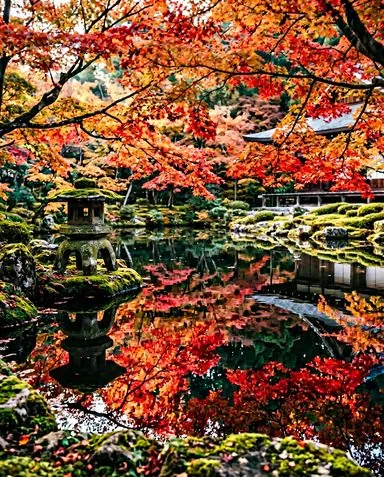

Japan in November is the insider's choice. Cherry blossom season gets all the headlines, but Kyoto's maples reach their most dramatic point in the last third of November, after October's crowded foliage weekends, before December's cold. Temperatures across central Honshu stay ideal for walking, and Kyoto draws fewer overseas visitors this month than it does in October. What it does not offer is a bargain: room rates in Kyoto are the highest of the autumn, so the month rewards booking early rather than booking cheap. This guide covers what to expect week by week, where to go, and how to time it.
What you need to know
The koyo front moves south and downhill from late October into December. Each bar is that region's peak window on the calendar below, so you can line your travel dates up against it.
- Tohoku and NikkoLargely over by the second week of NovemberColour begins Mid-OctoberPeak window October 20 – November 8
- Japanese AlpsKamikochi closes around November 15, so the window shuts earlyColour begins Late OctoberPeak window October 25 – November 10
- Kyoto and NaraTofuku-ji runs a few days ahead of Eikan-do and ArashiyamaColour begins Early NovemberPeak window November 18–30
- Hiroshima and western JapanThe last peak of the season, running into DecemberColour begins Mid-NovemberPeak window November 24 – December 7
Weather
November is one of the driest, clearest months in central Honshu: low humidity, reliable sunshine, and no typhoon risk after late October. Average temperature ranges by region:
Temperature by region in November
Typical low to high per region, north to south. Central Honshu sits in the comfortable band all month; Hokkaido does not.
- TokyoMild and dry. Evenings cool quickly from mid-month.10–17°C
- Kyoto and OsakaMidday in the mid-teens, evenings near 7°C by late November.8–16°C
- HiroshimaThe mildest of the main koyo cities, and the last to peak.9–17°C
- SapporoFirst snowfall is likely from early in the month.3–8°C
Rain is infrequent in central Honshu in November, but a few overcast days are normal.
Kyoto evenings drop sharply from mid-November. A light down jacket is essential from around the 15th. Rain is infrequent; carry a small umbrella but don't plan your days around it. Walking conditions in central Japan in November are as good as the country gets.
Autumn colour: week by week
The koyo (autumn foliage) front moves south through Japan from late September into December. The table below shows historical average peak windows; actual timing shifts by around one week depending on the season's temperatures. Recent warm autumns have run late rather than early: in 2025 Kyoto's maples were still turning on November 11 and only reached their best from late November into the first week of December.
| Week | Tohoku / Nikko | Japanese Alps | Kyoto / Nara | Hiroshima / western Japan |
|---|---|---|---|---|
| Early Nov (1–7) | Past peak | Peak / late | Green to first colour | Green |
| Mid Nov (8–15) | Done | Late colour | Building | Early colour |
| Late Nov (16–23) | Done | Done | Peak begins (Tofuku-ji first) | Building |
| Nov 24–30 | Done | Done | Peak, holding into early December | Peak, running into early December |
The practical implication: if Kyoto is your priority, target November 20 to December 1, and treat anything before the 15th as a gamble. Arashiyama and Nanzen-ji hold their colour into the first days of December, a few days behind Tofuku-ji. Combine with western Japan in the final week to catch Hiroshima and Miyajima at their best.
November vs other seasons: how does it compare?
The four most popular windows for Japan travel, side by side:
| Season | Highlight | Crowds | Kyoto prices | Weather |
|---|---|---|---|---|
| Late November | Peak koyo in Kyoto | Moderate | Highest of the autumn | 8–17°C, dry, sunny |
| Early–mid October (guide) | Tohoku + Alps peak; Kyoto building | High (peak weekends) | High, but below November | 15–22°C |
| December (guide) | Winter illuminations; foliage fading | Low–Moderate | Low–Moderate | 5–12°C, cold evenings |
| March–April (cherry blossom) | Sakura | Very high | Very high | 8–18°C, variable |
How to plan your November trip to Japan
Choose your window: early or late November
Early November (1–10) suits Nikko and the Japanese Alps. Colour peaks in these regions before mid-month. The Kamikochi valley in the Alps closes around November 15–16, so visit the first two weeks for mountains with autumn foliage. The last third of the month is the window for Kyoto and Nara. If Kyoto is your main destination, target November 20 to December 1 for the best chance of peak colour and the city's most atmospheric evening illuminations.
Build your regional circuit
A well-timed November circuit: Tokyo (2 nights) → Nikko day trip (first week, peak colour along the shrine approaches and at the lake) → Kyoto (3–4 nights, mid-to-late month) → Hiroshima day trip or overnight (last week, maple colour still at its peak in western Honshu). Tohoku, Sendai, Matsushima, catches its final colour in the first week of November. The Nikko guide covers the day-trip logistics from Tokyo.
Book accommodation months ahead
The November 22–23 public holiday weekend in Kyoto sells out hotel and ryokan inventory months in advance. Onsen ryokan within a short train journey from Kyoto fill even faster. Book as soon as your dates are confirmed. Weekday stays are significantly easier to secure and noticeably calmer when you arrive. The onsen guide covers options near Kyoto worth reserving well ahead.
Book the Kyoto evening illuminations separately
Kyoto's temples light their gardens after dark through the koyo weeks, and these evening sessions are ticketed separately from daytime entry. Kodai-ji runs nightly from late October into December. Eikan-do holds its session across the second half of November and the first days of December, roughly 17:30 to 21:00 for around ¥700; in 2025 it ran November 15 to December 10. Both temples confirm the year's dates in early autumn, so check before you fix your evenings. Queues at the gate are longest in the first hour after opening, so aim for the last ninety minutes instead.
November festivals and events
November's festival calendar is front-loaded: the biggest street festivals all fall in the first three days of the month, when Kyoto is still green and Tohoku is finishing. That makes them an argument for an early-November trip rather than an addition to a koyo itinerary. The two exceptions run later: the sumo tournament covers most of the month, and Takachiho's kagura season opens as the Kyoto maples peak.

Festival
Shichi-Go-San
annual2026-11-15 → 2026-11-15
Nationwide on November 15, which falls on a Sunday in 2026. Meiji Jingu draws the largest turnout, and it overlaps the start of the Kyoto colour window.
Observed nationwide on and around November 15, when families bring three, five and seven year olds to a shrine in formal kimono to pray for their health. There is no parade and no ticket: the appeal is simply the sight of it, and shrines fill with dressed-up families across the surrounding weekends. Meiji Jingu in Tokyo draws one of the largest turnouts in the country. In 2026 the 15th falls on a Sunday.
Dates, source
- Dates
- 2026-11-15 → 2026-11-15
- Source
- https://en.wikipedia.org/wiki/Shichi-Go-San

Festival
Kyushu Basho (Grand Sumo Tournament)
annual2026-11-08 → 2026-11-22
Spans most of the month, so it fits either half of a November trip. Fukuoka pairs with the western-Honshu leg that peaks in the final week.
The year's final grand sumo tournament, fifteen days at the Fukuoka Kokusai Center. Doors open early for the junior divisions; the top-division bouts run through the late afternoon and are what most visitors come for. Tickets go on sale in mid-September and the weekend days go first. The tournament always starts on the second Sunday of November.
Dates, source
- Dates
- 2026-11-08 → 2026-11-22
- Source
- https://www.buysumotickets.com/sumo

Festival
Karatsu Kunchi
annual2026-11-02 → 2026-11-04
The strongest of the early-November festivals and UNESCO-listed. Two hours from Fukuoka, so it combines with the sumo if your dates line up.
UNESCO-listed autumn festival: 14 enormous lacquered hikiyama floats (lion, samurai helmet, sea-bream) paraded through Karatsu on November 2-4 to the tune of a 400-year-old chant.

Festival
Takachiho Yokagura
annual2026-11-23 → 2027-02-08
Opens as Kyoto peaks and runs all winter. Performed nightly in farmhouses rather than for tourists, and well off the Tokyo to Kyoto line.
33-act sacred dance cycle performed nightly at farm-houses across Takachiho from late November through early February: a 1,300-year-old shamanistic Shinto tradition.
Two more worth knowing if your first days fall in the Tokyo area or western Honshu: the Hakone Daimyo Gyoretsu on November 3 sends a 170-person feudal procession down the old Tokaido at Hakone-Yumoto, and the Onomichi Betcha Matsuri (November 1 to 3, near Hiroshima) turns masked demons loose in the streets to chase children for luck.
Tips and common mistakes
- Use weekdays in Kyoto. The difference between a Tuesday and a Saturday at Tofuku-ji during late November is dramatic. If your schedule allows, keep your Kyoto nights to Monday–Thursday. Queues are shorter, paths are walkable, and the experience is closer to what the photographs promise.
- Go early at Tofuku-ji. The temple opens at 8:30 during November. Arriving at opening means the famous maple corridor is essentially yours: by 10:00 it's congested. Photography on the bridge is not permitted during peak season to keep the queue moving, but the viewpoints around it are unrestricted.
- Don't confuse October and November foliage timing. Many travel resources mix up Tohoku and Kyoto timing, leading visitors to arrive in early November expecting Kyoto to be at peak. It isn't. Plan for late November in Kyoto; early November elsewhere.
- Budget for the autumn's highest room rates. Kyoto's average room rate in November 2025 landed about 17% above October, and roughly 30% above October the year before. Peak colour and peak pricing arrive together. December is genuinely cheaper if colour is secondary, and October costs less if Tohoku and Nikko will do instead of Kyoto.
- Pack layers, not a heavy coat. In mid-November, midday temperatures in Kyoto can reach 15°C; by 18:00 it can be 7°C. A packable down jacket handles both ends. Leave the heavyweight coat at home until December.
- Kamikochi is closed from mid-November. The valley closes around November 15–16 each year. If the Japanese Alps are on your itinerary, schedule the visit in the first two weeks of the month.
FAQ
Is November a good time to visit Japan?
Yes, for many travellers it is the best time. November combines peak autumn foliage in Kyoto, ideal walking temperatures (8–17°C), low humidity, and no typhoon risk, and Kyoto hosts fewer overseas visitors than it does in October. The trade-off is cost: Kyoto room rates are the highest of the autumn, and late-November weekends sell out months ahead. For the full seasonal comparison, see the best time to visit Japan guide, or the October guide for the month before.
When exactly does autumn colour peak in Kyoto?
Kyoto's maple colour peaks in the last third of the month: roughly November 20 to the first days of December, with Tofuku-ji a few days ahead of Eikan-do, Nanzen-ji and Arashiyama. The exact timing shifts by about a week with that autumn's temperatures, and recent warm autumns have run late rather than early. In 2025 the colour was still building on November 11 and reached its best from late November into early December. Japan's foliage forecasts are published from October onward: worth consulting once your travel dates are set.
How does November compare to cherry blossom season?
November is meaningfully less crowded and cheaper than late March to early April. Cherry blossom in Kyoto draws large numbers of foreign visitors; late November draws mostly Japanese domestic day-trippers. Autumn colour in Kyoto typically lasts 2–3 weeks in a good year; cherry blossom peaks for 7–10 days and is sensitive to rain and wind. For longevity of colour and quality of experience, November regularly edges ahead.
What should I pack for Japan in November?
Layers work better than a single heavy coat. A packable down jacket handles Kyoto evenings from mid-November. Comfortable walking shoes are essential. You'll cover considerable distances at temples and gardens. Carry a compact umbrella: November in central Honshu is mostly dry but a few overcast days are likely. Heading north to Tohoku or Sapporo? Plan for significantly colder conditions and possible snow.
What's the best base for a November trip to Japan?
Kyoto is the strongest base for late-November visits. Central to peak foliage and within easy day-trip range of Nara, Osaka, and Hiroshima. For early November, Tokyo works equally well with Nikko two hours north at its autumn peak. A split base, Tokyo for the first week, Kyoto for the second, covers the koyo progression well and requires only one shinkansen transfer.
Is it too cold to visit Japan in November?
Not for most of the country. Tokyo and Kyoto in early November feel like a mild European autumn. By late November, Kyoto evenings are properly cold (7–8°C) but midday stays in the mid-teens: comfortable for walking between temples. Hokkaido is genuinely cold; Sapporo typically sees its first snow in early November. The further south you travel (Hiroshima, Kyushu), the milder conditions remain through the end of the month.