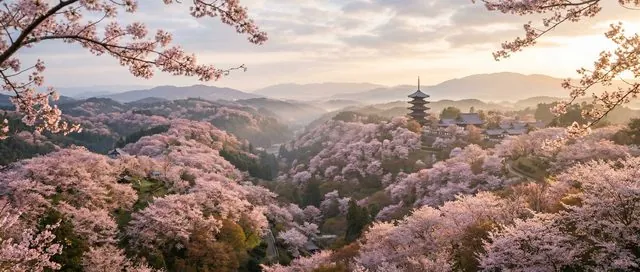

Cherry blossom season in Japan isn't a single date. It's a wave that rolls from the subtropical south to the snowy north over roughly four months. This guide gives you the region-by-region bloom calendar, explains how the forecast works and how far you can trust it, and shows you how to plan a trip that actually lands on peak.
What you need to know
Three things shape every sakura trip. First, the bloom moves geographically: it starts in the far south and the warm lowlands and works its way north and up into the mountains over weeks. Second, the window is short. Once a city hits full bloom, you have roughly a week before petals fall, sooner if it rains or turns windy. Third, the exact dates move every year with winter temperatures, so the only reliable plan is a target week plus a close eye on the annual forecast.
When do the cherry blossoms bloom? A region-by-region guide
The blossom wave sweeps Japan over roughly four months. First bloom is when the first flowers open; peak is full bloom, the week you want to be there.
- OkinawaA different deep-pink early variety, far ahead of the mainlandFirst bloom Mid-JanuaryFull bloom (peak) Late January – early February
- Kyushu & the warm southWhere the mainland front startsFirst bloom Mid-to-late MarchFull bloom (peak) Late March – early April
- Tokyo & KantoThe most-watched forecast in the countryFirst bloom Around late MarchFull bloom (peak) First week of April
- Kyoto, Osaka & KansaiOften a few days behind TokyoFirst bloom Late MarchFull bloom (peak) Early-to-mid April
- TohokuYour second chance after the big cities finishFirst bloom Mid-AprilFull bloom (peak) Mid-to-late April
- HokkaidoThe last act, often overlapping Golden WeekFirst bloom Late AprilFull bloom (peak) Late April – early May
"First bloom" is when the first few flowers open; "full bloom" (the peak you want) usually follows about a week later. These are typical windows, not guarantees.
| Region | Typical first bloom | Typical full bloom (peak) | Notes |
|---|---|---|---|
| Okinawa | Mid-January | Late January – early February | A different, deep-pink early variety; far ahead of the mainland |
| Kyushu & the warm south | Mid-to-late March | Late March – early April | The mainland front starts here |
| Tokyo & Kanto | Around late March | First week of April | The most-watched forecast in the country |
| Kyoto, Osaka & Kansai | Late March | Early-to-mid April | Often a few days behind Tokyo |
| Tohoku | Mid-April | Mid-to-late April | Your second chance after the big cities finish |
| Hokkaido | Late April | Late April – early May | The last act, often overlapping Golden Week |
The practical upside of this spread: if you miss peak in one region, another is just coming into bloom. A trip timed for early April in central Japan can still catch the front edge in the south on arrival and the start of the northern bloom on the way out.
How the cherry blossom forecast works
Every year from around late January, Japan's weather agency and several private forecasters publish bloom predictions and update them through February and March as temperatures firm up. Two terms matter: kaika, the first-bloom date, and mankai, full bloom, the peak you're actually planning around. A warm winter pulls the dates earlier; a cold snap pushes them later. Forecasts get steadily more accurate as the date approaches, but even in March the peak can move by several days, so treat any single date as a centre point, not a promise. Start checking forecasts about six weeks out and keep checking right up to departure.
How to plan around peak bloom (and the crowds)
Peak sakura is the most beautiful and the most expensive, most crowded time to be in Japan. A little structure keeps it from going wrong.
Pick your region and target week
Decide where you most want to see the blossoms, then use the table above to set a realistic target week for that region.
Follow the forecast from February
Start watching the annual bloom forecast about six weeks out and keep checking; the peak can shift by several days as the date nears.
Book flexible accommodation early
Reserve flights and refundable hotels 5–6 months ahead; sakura is peak demand and prices climb fast for the popular weeks.
Beat the crowds on the day
Visit famous spots on weekday mornings, and consider the shoulder week: a few days before or after peak is far quieter and still lovely.
Tips & common mistakes
- Don't pin a non-refundable trip to one exact date. The peak moves; build in a few days of slack and keep bookings flexible.
- Use the geography. If your dates are fixed, the south blooms earlier and the north later. Pick the region that fits your window rather than forcing the calendar.
- Travel the shoulder week. The few days just before full bloom (with early blossoms and budding branches) or just after (with falling petals) are quieter and genuinely beautiful.
- Budget for the premium. Sakura weeks carry the year's highest prices; see our Japan travel budget guide before you commit.
- Mind Golden Week. In the far north the bloom can run into Golden Week (late April to early May), stacking sakura crowds on top of holiday crowds.
FAQ
When is the best time to see cherry blossoms in Japan?
For the major cities (Tokyo, Kyoto and Osaka), the last days of March through the first week of April is the typical peak. Aim for that window, then fine-tune with the annual forecast.
How long does cherry blossom season last?
In any one city, full bloom lasts only about a week, and less if it rains or turns windy. Nationwide, though, the season stretches from January in Okinawa to early May in Hokkaido.
What happens if I miss the peak?
You're rarely far from blossoms somewhere. If the big cities have finished, head north: Tohoku peaks in mid-to-late April and Hokkaido into early May.
How reliable is the cherry blossom forecast?
Quite reliable close to the date, less so early on. Forecasts begin in late January and tighten through March, but the peak can still shift several days, so keep checking and stay flexible.
Where should I go to see the cherry blossoms?
Kyoto and Tokyo are the classic choices and bloom at roughly the same time. For fewer crowds, travel a region earlier or later than the big-city peak. Browse our cherry blossom guides for ideas.
Will the timing be different next year?
Yes. The exact dates shift every year with winter temperatures, typically by up to a week in either direction. The regional order stays the same, but always check the forecast for your travel year.