



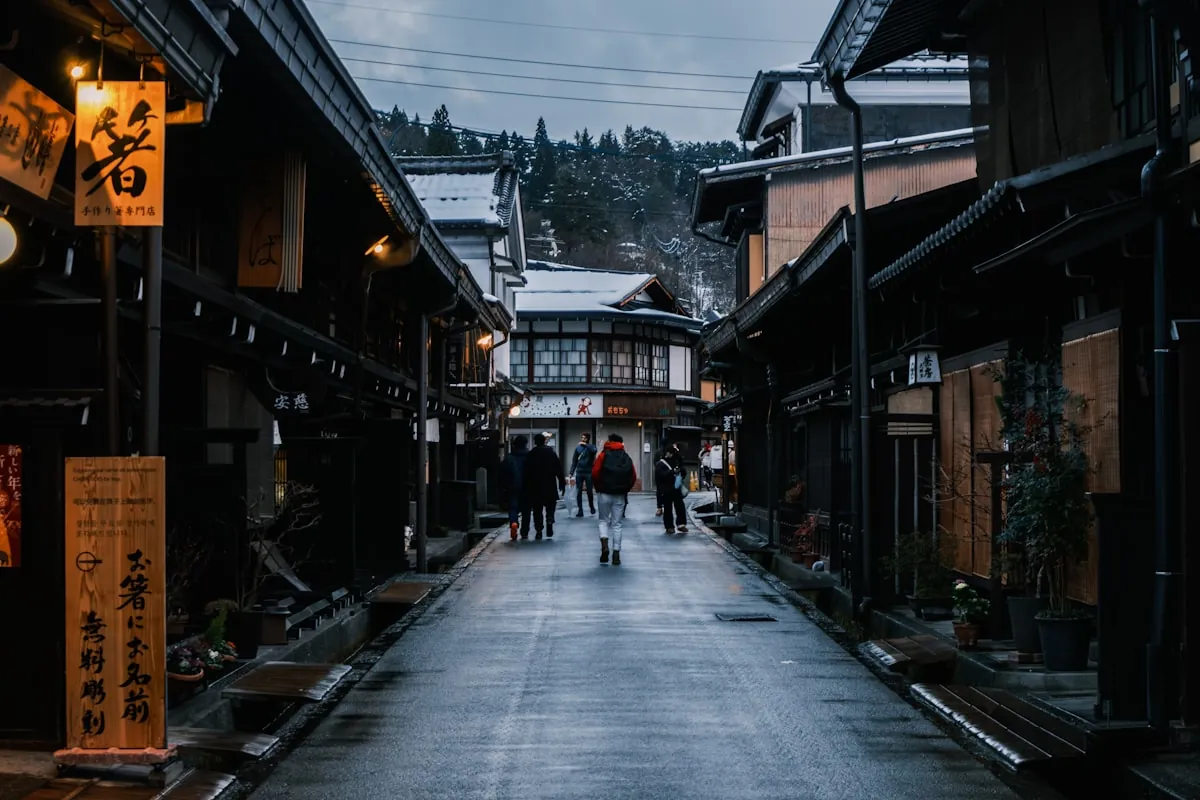
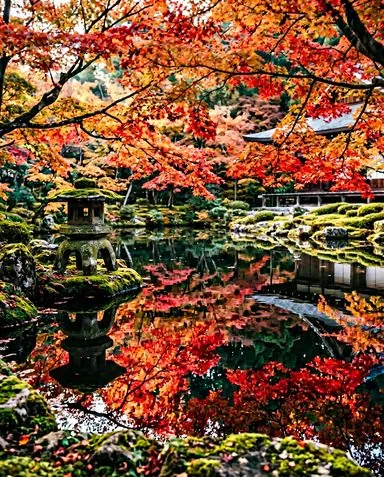

Ome sits 57 km west of Shinjuku and belongs to a different Japan. The town's identity is Showa-era nostalgia (1926 to 1989): hand-painted film posters line its main street, a private museum holds three floors of postwar advertising art plus a room tied to the yuki-onna legend that the writer Hearn documented, and a gorge 20 minutes further along the Ome line offers 4 km of flat riverside walking with autumn colour that rivals Nikko. English travel guides have almost entirely ignored Ome. That is precisely why it works.
What to expect
Ome organises into three distinct layers that can be combined or visited separately. The retro culture quarter sits within walking distance of Ome station and fills a half-day on its own. Mitake Gorge and Musashi-Mitake Shrine are 20 minutes further on the same JR line, at Mitake station, and together they round out a full day. Nothing here requires advance booking or special equipment.
The retro culture quarter
The Ome Film Poster Street is the most immediate expression of the town's character. For three decades until 2019, the station building itself was covered in hand-painted vintage film billboards. The tradition migrated to the surrounding streets of the Ome kaido, the old main road through town, where shops, galleries, and restaurants now carry the visual language of 1950s and 1960s Japanese cinema. Poster subjects range from domestic melodramas to Hollywood imports of the era, all rendered by hand in the bold commercial style of the period. This is not a themed museum installation: the posters are still live commercial signage, which gives them a vitality that purpose-built exhibits rarely match.
- Getting there from Ome station: 5-minute walk
- Time needed: 30 to 60 minutes to walk the stretch properly
- Admission: Free (street-level)
Five minutes on foot from the poster street, the Showa Retro Goods Museum is the anchor attraction of the retro quarter. Three floors of private collection document the postwar decades through the objects people actually used and bought: advertising packaging in vivid colours, tin toys from the first consumer boom, confectionery boxes, and promotional materials that show how Japan's design culture formed in real time under Western and traditional influences simultaneously.
Upstairs, one room is given over to the yuki-onna, the snow woman of Japanese folklore. The writer Hearn, an Irish-Greek emigrant who became a Japanese citizen, heard the legend from a farmer in Nishitama, the district that now includes Ome, and published it in "Kwaidan" in 1904; the museum displays materials tied to that local telling. Allow 45 minutes to an hour for the whole building.
- Hours: 10:00–17:00; closed Mondays (Tuesday when Monday is a holiday)
- Admission: ¥350 adults, ¥200 children
- Getting there from Ome station: 10-minute walk
Mitake Gorge
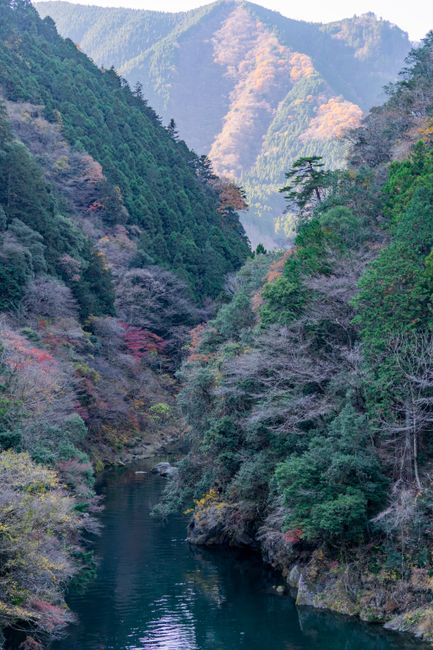
Twenty minutes from Ome station on the Ome line, Mitake Gorge (Mitake-keikoku) begins just beyond Mitake station. A 4 km path follows both banks of the Tama river, designated one of Japan's 100 most beautiful waterways, through a gorge lined with maple and ginkgo trees. The walk is flat throughout and takes 90 minutes to two hours at a comfortable pace; no trail experience or hiking gear required. From mid-to-late November, the foliage peaks and the gorge hosts the annual autumn colours festival, with evening illuminations that transform the riverbanks. Outside the foliage season, the path stays quiet on weekdays and the river scenery holds year-round interest.
- Trailhead: Mitake station (20 min from Ome on the JR Ome line)
- Walk length: 4 km (flat, easy)
- Best season: Mid-to-late November (peak foliage); April–May (green season, minimal crowds)
Musashi-Mitake Shrine
From Mitake station, a 10-minute bus ride reaches the base of the Musashi-Mitake Shrine ropeway. The cable car carries you to 831 m in about six minutes (¥600 one-way, ¥1,200 return for adults; ¥300/¥600 for children; runs 7:30–18:30, every 30 minutes). A 20-to-30-minute walk from the top station reaches the shrine complex at 929 m, a mountain sanctuary whose founding tradition reaches back nearly two millennia. The plateau holds a small resident community of shrine priests and their families. The atmosphere is one of lived-in mountain quietude, entirely different from Tokyo's urban shrine culture. On clear days, the views stretch west toward the Okutama mountains and east toward the city.
- Bus from Mitake station: 10 min to cable car base
- Cable car: ¥600 one-way / ¥1,200 return (adults); runs 7:30–18:30
- Walk to shrine from top station: 20–30 min
Getting There
- 1Take JR direct rapid service on the Chuo-Ome line (no transfer required) → Ome
- 2Walk to Ome town centre → Ome town centre
- 3Or continue on the JR Ome line toward Okutama for the gorge and shrine → Mitake station
The whole rail journey is covered by the JR Pass; otherwise just tap in with an IC card (Suica/Pasmo).
- 1Take JR Chuo rapid toward Takao or Hachioji → Tachikawa station
- 2Change to JR Ome rapid toward Okutama → Ome
Covered by the JR Pass; otherwise tap in with an IC card.
Tips
- Half-day plan: Stay in the Ome station area. Walk the Ome Film Poster Street, spend an hour at the Showa Retro Goods Museum, eat in the old town, and head back by early afternoon. Allow 3 to 4 hours from central Tokyo and back.
- Full-day plan: Add Mitake Gorge and the Musashi-Mitake Shrine cable car. Start by 09:00 from Shinjuku to make the most of daylight, especially in the shorter November afternoons. Allow 7 to 9 hours total.
- Avoid November weekends at the gorge. The autumn foliage festival draws significant crowds on Saturdays and Sundays in mid-to-late November. Weekdays in the same window are noticeably quieter.
- JR Pass coverage: The direct rapid service and ome line trains to Mitake are fully covered by the standard JR Pass. The cable car at Mitake is a private operator and is not included.
- Ask about the stamp rally. The tourist office by Ome station runs a stamp-rally walking route that strings the old-town landmarks together, including the Showa Retro Goods Museum. Check there whether it is running on your date.
Nearby
Ome and Mitake connect naturally to the wider western Tokyo outdoors and day-trip circuit.
FAQ
How do I get from Tokyo to Ome?
Take the JR direct rapid service on the Chuo-Ome line from Shinjuku station. Services run without a transfer and reach Ome station in approximately 75 to 85 minutes. JR Pass holders travel on this route for free; everyone else simply taps on and off with an IC card (Suica or Pasmo). No advance booking is needed.
Is a half-day or full day better for Ome?
A half-day is fully satisfying if you stay in the Ome station area: the Ome Film Poster Street plus the Showa Retro Goods Museum takes two to three hours, with time for lunch. A full day pays off if you continue to Mitake Gorge and the Musashi-Mitake Shrine cable car, which together add another four to five hours. Both plans share the same base fare and the same trains: the choice is simply how far along the line you ride.
When is the best time to visit Ome?
Mid-October to late November for autumn foliage at Mitake Gorge, peaking in mid-to-late November. April and May are good for comfortable walking without the autumn crowds. The retro quarter itself is a year-round, all-weather visit.
What is the snow-woman room in the Ome retro museum?
Upstairs in the Showa Retro Goods Museum, one room is devoted to the yuki-onna legend. The writer Hearn heard the story from a farmer in Nishitama, the district that now includes Ome, and published it in "Kwaidan" (1904); the room displays materials tied to that local telling. It is the museum's most unusual exhibit, distinct from the advertising and consumer goods collection on the lower floors.
Is Mitake Gorge the same as Mitake (Mount Mitake)?
No. They are adjacent but separate destinations reached from the same station. Mitake Gorge (Mitake-keikoku) is the riverside walk along the Tama river, accessible on foot from Mitake station. Musashi-Mitake Shrine requires a bus from Mitake station to the cable car base, then the ropeway up to 831 m. Both are reachable in a full-day visit, or you can choose one depending on how much walking you want to do.