
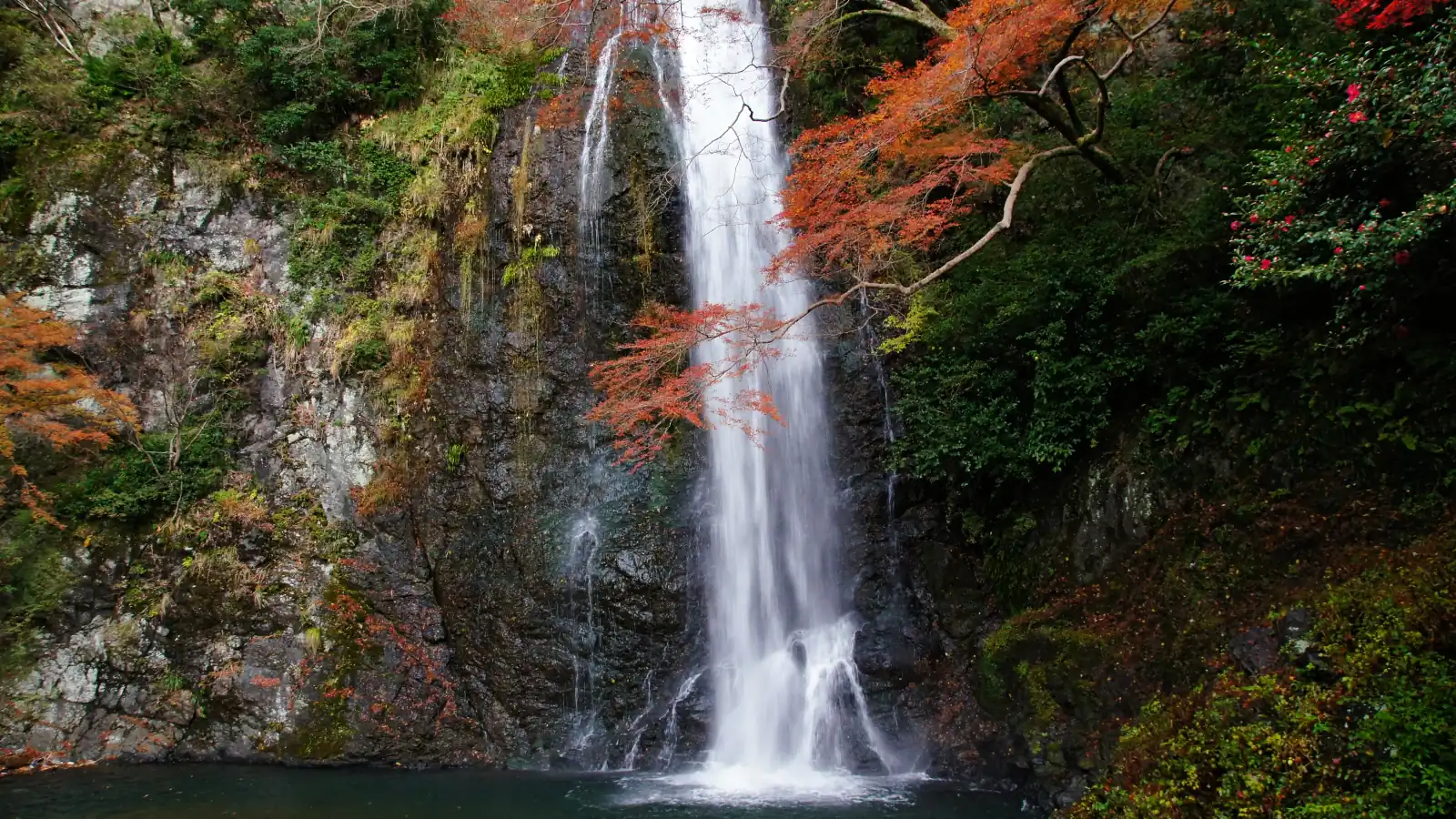
Minoh Falls sits at the end of a 3-kilometre paved trail through Meiji-no-Mori Minoo Quasi-National Park, a strip of mountain forest pressed against the northern edge of suburban Osaka. The walk from Hankyu Minoo Station takes about 45 minutes uphill at a gentle grade, ending at a 33-metre vertical drop into a small basin. The trail is what most people remember: wooded canyon walls, a temple halfway up, and a parade of food stalls selling deep-fried maple leaves that you'll either love or politely return.
It's the easiest forest daytrip from central Osaka, and the most under-visited one outside of November. The autumn-foliage peak from mid-to-late November fills the trail by 10:00; the rest of the year, the same walk costs you nothing and clears your head before lunch back in Umeda.
When to Visit
Most visitors come in November for the autumn leaves; the rest of the year tells a different (quieter) story about the same trail.
Springharu
Mar – May10–22°CModerate crowds
Springharu
- Fresh green canopy through Meiji-no-Mori
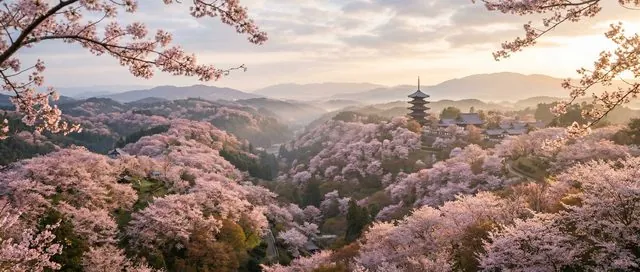
- Cherry blossoms along the lower trail in early April
- Pleasant hiking temperatures, light crowds outside Golden Week
Summernatsu
Jun – Aug24–34°CLow crowds
Summernatsu
- Forest canopy provides shade; cooler than the city
- Heaviest fall volume at the waterfall after rainy season
- Bring water; no vending machines past Ryuanji Temple
Autumnaki
Sep – Nov12–22°CHigh crowds
Autumnaki
- Peak momiji mid-to-late November
- Evening light-up of the trail on November weekends
- Busiest weekend of the year is the third Saturday of November
Winterfuyu
Dec – Feb2–10°CLow crowds
Winterfuyu
- Empty trail, cold air, low water flow still photogenic
- Momiji tempura stalls open weekends only
- Otowa-Sansou onsen makes the natural evening capper
What to Expect
The trail starts directly across from Hankyu Minoo Station. Turn left from the exit and you'll see the wooden archway and the river within two minutes. From there the path is paved the whole way: a wheelchair-passable surface that follows the Minoo River upstream through the forest. The climb is steady but never steep, and signposts in English mark the distance remaining (3.0 km → 2.5 → 2.0 …) every couple of hundred metres.
Roughly twenty minutes in, you'll pass Ryuanji Temple, a small Buddhist mountain temple founded in 658 CE that's the most architecturally interesting stop before the falls. Past Ryuanji the trail narrows briefly, then opens out at the basin where the water drops in a single column into a wide pool surrounded by maples. The viewpoint plaza holds maybe sixty people comfortably; on a peak-autumn Saturday it holds a hundred and twenty.
Momiji Tempura: the Snack You Came For
The Minoo specialty is momiji tempura: salt-pickled maple leaves (specifically the Ichigyokaede variety, aged at least a year in salt), then deep-fried in a sweet sesame-sugar batter. They look more like crisp brown wafers than leaves, and the taste is closer to a churro than a tempura. A bag of ten runs around ¥300–500; verify current pricing at the stalls along the lower trail. Most stalls open from late morning to mid-afternoon; in winter they trade only on weekends and holidays.
Where to Stay
Most visitors daytrip from central Osaka; the only on-site stay worth crossing the city for is Otowa-Sansou, a 1926 ryokan built into the maple forest itself.
Otowa-Sansou$$$
Pre-war ryokan tucked into Meiji-no-Mori, with kaiseki dinner and an open-air bath on a maple-shaded terrace. Books direct via the official site, IKYU, or Hotels.com; no Booking.com listing.
Minoo ParkView on Google Maps →If you'd rather stay in the city and treat Minoh as a half-day, central Osaka has the full range of business hotels around Umeda and Namba. See our Osaka city guide for the standard list.
Food & Drink
Three sit-down restaurants line the lower trail back toward Minoo Station, in the same wooden buildings that have served hikers since the early Showa era. The most established is Isoyoshi, a riverside Japanese restaurant on the trail itself, with set meals around ¥4,000–4,800 per person (verify current pricing). The original Meiji-era inn at Hashimoto-tei was destroyed in the 2016 disaster; the current café-gallery is a faithful replica worth a stop for tea but not a full meal. Beyond those, Tabelog and Google Maps surface the current openings around Minoo Station; many small counters close on Tuesday or Wednesday, so plan a backup.
How to Get There
Getting There
- 1Hankyu Takarazuka Line from Umeda to Ishibashi handai-mae → Ishibashi handai-mae Station
- 2Transfer to Hankyu Minoo Line (cross-platform) → Minoo Station
- 3Walk from Minoo Station to the trailhead → Minoo Park entrance
- 1JR Kyoto Line to Osaka Station, then Midosuji Line to Umeda; or Hankyu Kyoto Line direct to Juso, transfer to Hankyu Takarazuka Line → Ishibashi handai-mae
- 2Transfer to Hankyu Minoo Line → Minoo Station
Note: Hankyu lines are NOT covered by the JR Pass. A single-day Hankyu Tourist Pass covers the round-trip if you also use the line elsewhere in Osaka; otherwise just pay the fare with your IC card.
Tips
- Go on a weekday morning in November. The autumn-leaves peak (mid-to-late November) draws bus tours by 10:00 on weekends. A Tuesday or Wednesday arrival before 09:00 gives you the falls largely to yourself.
- February is the underrated season. Low water flow still photographs well, the air is cold and clear, and the trail is empty. Most stalls run weekends only, so bring a thermos and the round-trip becomes a quiet two-hour walk.
- No vending machines past Ryuanji Temple. Stock water and a small snack at Minoo Station before you start, especially in summer.
- Combine with a tour for the day. If you're piecing together other Osaka spots (Dotonbori, Osaka Castle, Shitennoji), a guided Osaka day tour can fit Minoo as a morning leg.
- Onsen capper. Otowa-Sansou's open-air bath is open to non-staying guests in the afternoon (verify current admission and hours). It is a 20-minute walk back uphill from the lower stalls, and the natural finish to a winter visit.
- Wheelchair-passable to the second viewpoint. The paved trail is gentle enough for assisted wheelchair use as far as the bridge before the falls. The final 50 metres to the basin platform involve a short stepped section.
FAQ
Is Minoh Falls worth visiting?
Worth it as a half-day from Osaka if you want forest and a real waterfall within easy train range, and especially worth it for the off-peak months. The walk is gentle, paved, and short enough that even non-hikers manage it. Less worth it if you're chasing dramatic scale: at 33 metres the fall is modest by Japanese standards (Nachi is 133 m). What you come for is the forest, not the cascade.
How long does the Minoh Falls hike take?
Allow 45 minutes one way at a gentle pace, plus 20–30 minutes at the falls and any stops at Ryuanji Temple and the food stalls. A round-trip with lunch fits inside three hours from Minoo Station; a brisk return walk takes about 30 minutes downhill. Most visitors are back at the station within two and a half hours of arrival.
Can you visit Minoh Falls in winter?
Yes. The trail is open year-round and is one of the quietest forest walks near Osaka in February. Water flow is lower than in summer but the fall is still photogenic, the air is cold and clear, and the trail crowds drop to a handful per hour on weekdays. Momiji tempura stalls operate weekends only in winter. Wear layers; the basin is several degrees cooler than the city.
How do I get to Minoh Falls from Osaka?
From Umeda, take the Hankyu Takarazuka Line to Ishibashi handai-mae (about 16 minutes), transfer cross-platform to the Hankyu Minoo Line, and ride to Minoo Station (about 9 minutes). Total journey is around 25 minutes plus a 2-minute walk to the trailhead. The Hankyu Tourist Pass covers it if you'll use Hankyu elsewhere in Osaka; otherwise pay around ¥280 each way with your IC card (verify current fare).