



At a glance
- Alert
- 5–30 sec lead
- Code
- Drop, cover, hold
- Tsunami
- Up & inland
The first time a Japanese earthquake hits while you are eating dinner is unforgettable. Every phone in the restaurant goes off at once with the same chord. The waiter glances at the ceiling, says jishin desu ne, and keeps clearing plates. Twenty seconds later the room sways like a slow boat. Nobody stands up. The whole event is over in a minute and the conversation resumes mid-sentence.
Western media frames Japanese earthquakes as catastrophes. The Japanese infrastructure frames them as routine traffic. Both are right, depending on the magnitude, and the fastest way to feel safer here is to understand which one you are actually in. Here is the playbook.
How-to
What to do in the 30 seconds you have
Recognise the alert in the first second
When the ground is about to move, every phone in the area screams the same chord and pushes the same lock-screen card: a yellow Earthquake Early Warning. It is loud on purpose, even on silent. The alert reaches you 5–30 seconds before the actual shaking, depending on how far you are from the epicentre. That window is the entire point of the system: enough time to drop, not enough to think.
Mocked Earthquake Early Warning push notification on a phone lockscreen, English text, yellow caution badge Tip: The alert is in Japanese first and English second on most phones. The chord is identical worldwide. The moment you hear it, act, then read.
The 30-second drill: drop, cover, hold
Stop walking. Get under the nearest sturdy table or desk. If there is no table, kneel against an interior wall away from windows, glass and tall furniture. Cover the back of your neck with one arm. Hold on. Wait until the shaking fully stops; most events finish inside 30–60 seconds. The instinct to run outside is wrong: most injuries in Japanese earthquakes come from falling glass or shelving, not collapsing buildings.
In a hotel room, on a train, on the street
Hotel room: drop next to the bed, pull the duvet over your head and shoulders. Modern hotels (anything built since the 1981 seismic code) are designed to ride the wave; the building moves, the contents fall. Train or shinkansen: the system brakes automatically the moment a P-wave is detected. Sit down, hold a rail, wait for the conductor. Street: move away from buildings into open space (parks, pedestrian crossings); ignore overhead signs and air-con units.
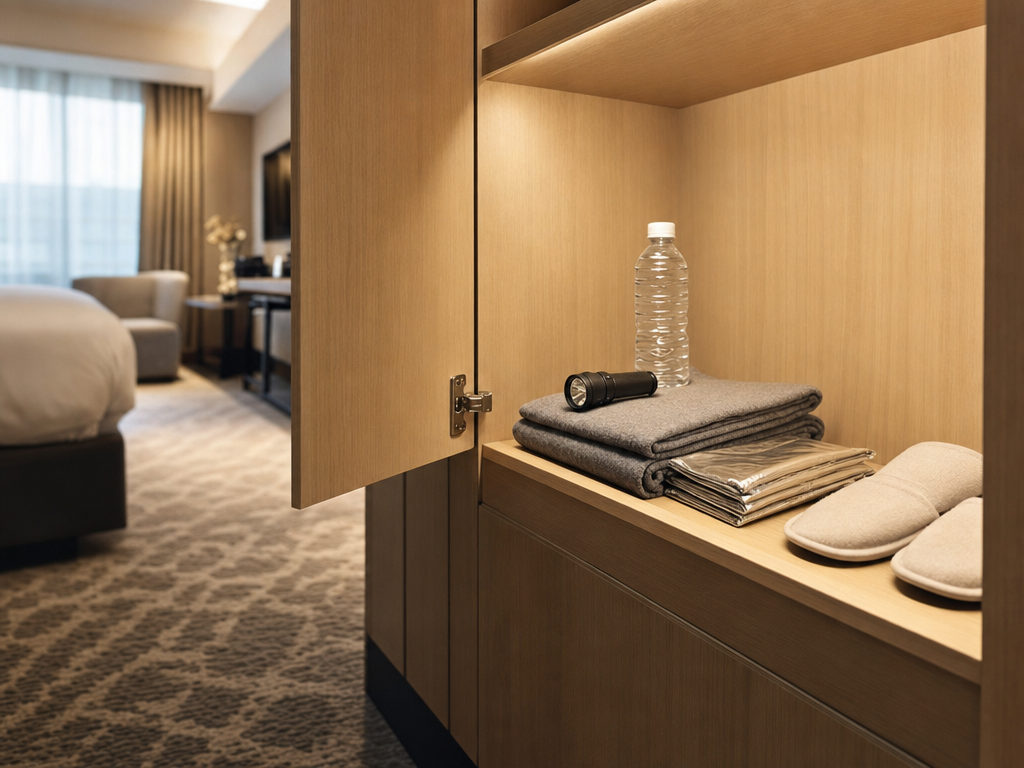
Most Japanese hotels keep a small kit in the wardrobe (flashlight, water, thermal wrap). Open the cupboard the moment you check in so you know where it lives. After the shake: assess, then continue
When the ground stills, check yourself, then look at the room: anything fallen, anything broken, smell of gas. Open the door early, because earthquake-warped frames can jam shut after large events. If you are above the third floor, take the stairs (lifts auto-stop and need a human reset). Otherwise, carry on with your day. 95% of the alerts you will hear in Japan are minor; the news will not even cover them.
Japan Meteorological Agency · live earthquake feed(opens in new tab)Tsunami advisory: a different rule
If the alert is red and says Tsunami, ignore everything above. You have ~15–30 minutes (sometimes less) to move uphill or inland from any coastline or river mouth. Hotels in coastal areas (Kamakura, Atami, the Tohoku coast) have evacuation routes posted in the lobby and on the back of every door. Walk, do not drive; roads jam in seconds.
Mocked tsunami advisory push notification, red caution badge, English text
A few things worth knowing
- Foreign SIMs get the alert too. The Cell Broadcast system is independent of carrier: Airalo, pocket-WiFi tethering, anything with a Japanese cell connection rings. The only way to miss it is airplane mode.
- The 1981 building code is the line. Anything built or seismically retrofitted after 1981 is designed to survive a magnitude-7. Modern Tokyo high-rises sit on base isolators; they sway visibly during a quake, which is them working, not breaking.
- Hotel emergency kits are real. Almost every modern hotel has a small bag in the wardrobe (flashlight, sealed water, thermal wrap, sometimes a whistle). Open the cupboard at check-in so you know where it lives.
- Aftershocks are normal. A magnitude-5 main shock is often followed by 3–4 smaller ones over the next hour. The phones will alert again. The building will sway again. The waiter will still keep clearing plates.
- Volcano alerts use the same system. If you are near Mt. Aso, Sakurajima, or Hakone, the same lock-screen card can carry an eruption warning. Same drill: read the colour, follow the local evacuation route.
- Drills exist for tourists. Tokyo’s Honjo and Ikebukuro Bosaikan (disaster museums) let you stand on a magnitude-7 simulator for free, with English commentary. Useful 90 minutes if it is your first long Japan trip.
You will feel one. It will be fine.
Stay in Japan for two weeks and you will almost certainly feel an earthquake. You will glance at the ceiling, the locals will glance at the ceiling, and life will continue. The country has spent 140 years engineering itself around the problem; the only thing it asks of you is the 30-second drill. Practice the drop-cover-hold once in your hotel room on day one and you have done your part.